Sunday, February 22, 2009

Travel - What is it Good For?

I travelled quite a bit as a kid, with my parents taking me around North America and Europe on several occasions; however, in the last few years I've barely left B.C. and I seemed to forget about travel as an enjoyable activity. Luckily, those dark days are gone, as I recently caught a bad case of the travel bug and have spent much of my procrastination time this term thinking about it, so I figured a blog post on the matter would be only appropriate!


Its safe to say that travel and tourism are massive industries and often the biggest contributor to a developing country's GDP. Many who travel sing praises about it and its benefits to the traveller in terms of opening their eyes to the world. However, travel isn't all sunshine and smiles, as it causes huge environmental degradation. Inter-continental airplane flights alone have many associated impacts, including the release of huge amounts of CO2 from the jet fuel, but also the energy intensive production of the plane itself, as well less tangible factors like noise pollution.
Once at the destination, the traveller often becomes much more callous towards things like their waste output ("Recycle? F*ck that, I'm on vacation. Another mojito, boy!"), and the hotels and resorts that have been established to accommodate travellers are often hugely energy and waste intensive ("We spare no expense for our guests' comfort!"), and, as well, their construction often occurs within ecologically sensitive areas, since those are usually where the "nice views" are (e.g. the Burj Al Arab in Dubai or resorts along Latin American beaches).
Cruise ships are no better, often emptying their raw wastes right into the ocean, not to mention promoting a lifestyle of gluttonous excess.



Finally, many popular travel destinations are ecologically or historically sensitive areas, and, as beautiful as they may be (e.g. Machu Picchu, the Galapagos, the Indonesian or Brazilian rain forests, etc.), the more people that travel to these areas leads to more strain on their integrity, through such issues as the introduction of invasive species or the erosion of the local culture and loss of its language / history.

Damn, so why travel at all? And is there a way to do it sustainably?

Yes and no. To return to my tribalist ideals for a moment: in theory, none of us should travel, as any movement on our part has an environmental impact. In practice, of course, that isn't gonna happen. Travel, of course, isn't all bad - there is definitely something to be said for the potential life-changing inspiration that we "Annex I" nationals can obtain from travel to areas poorer than ours. But how can we value this non-tangible benefit with the very tangible downfalls listed above? While difficult, I would venture a guess that the net downfalls are currently exceeding the net benefits, if only because of our massively increasing population of travellers.


So how can we change this? - A change in mindset and priorities.
There are many increasingly popular forms of (more) sustainable travel, but they require us to shift from a destination- and "me"-focused mindset to a journey- and "us"-focused one instead. What do I mean by this? Well, compare these 2 possible trips:
1) Flight to Mexico, Drive to gated-resort community, Lounge on the beach being served by locals, Party in your 5-star resort
2) Hop on a cargo ship over to Asia, travel around the countries there by train, interacting with the locals, and volunteering with local social or environmental groups
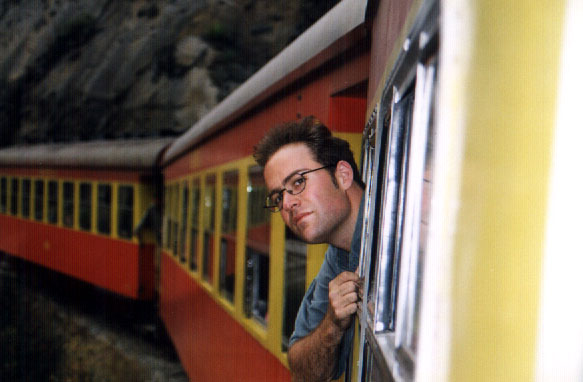

While the second trip is by no means environmentally perfect, I would argue that it is the ideal that we must strive for in our travel, since not only does it reduce our environmental impact, but it also reminds us that we are guests - not Kings - in foreign lands and must conduct ourselves with a great deal of respect if we are to be given the same in return. I would argue that this second trip would strengthen our social capital (participation, connections, tolerance of diversity, value of life, social agency) immensely, slow our pace of life, make us appreciate things we normally wouldn't, and allow a greater opportunity for the aforementioned life-changing inspirations to occur. For example, we could learn such little things as sharing!:

http://blog.islandpress.org/297/tim-beatley-can-americans-learn-to-share

I am, of course, a realist, and know that resorts and travel for luxury purposes will continue to pervade our world, so first-order changes must accompany these lofty second-order changes. The eternal quick fix is technology, which we can harness to reduce our travel impacts immediately while the charismatic idealists among us go about promoting a future new way of life.
For example, eco-resorts have begun to take off, with a particularly impressive one being built in California:


http://earth911.com/blog/2009/02/04/new-resort-to-be-most-eco-innovative-in-world/

Recent advances in biofuels for aircraft are also giving cause for optimism. For example, the first test flights were recently completed using jatropha - a plant-based oil:

http://www.businessgreen.com/business-green/news/2233235/air-zealand-delcares-first

Big names are also now talking about the emissions from ships, which carry ~90% of the world's international trade goods:

http://news.alibaba.com/article/detail/finance/100010048-1-un-body-finalise-action-ship.html


All of this comes back to my original point, which is that I myself hope to travel sustainably in the coming years. Once I scrounge together enough money, I hope to completely circumnavigate the globe without the use of air travel. My attempted route will be ambitious (Vancouver to the East Coast via train, ship to Europe, train through Europe, travel with an overland truck expedition down and up through Africa, train back through Europe again, train across Asia to Beijing, train back through China to Tibet, Bhutan, and Nepal, then more trains around India, a ship from India to Southeast Asia, train around Laos / Vietnam / Cambodia / etc., ship down to Australia and travel around there, ship across to South America and do likewise, then travel up through the Caribbean to Florida and back home North-west through the States) and would take several years.
I would also attempt to give back as much as I could, through innovative volunteer projects such as those from the Global Volunteer Network:

http://www.volunteer.org.nz/programs/

or something a bit more off-the-beaten-path, such as WWOOF-ing (volunteering on an organic farm):

http://www.wwoof.org/

Large sums of monetary donations will be happily accepted to help my cause! :)

In short, travel is a key area that we can all work on to reduce our ecological footprints. By changing the way we travel, we can not only help maintain our environment, but also foster a much deeper sense of global community and social capital within ourselves!

Until next time..

Tuesday, February 17, 2009

Geo-Engineering and Other Technology Stuff

I used to brag to myself that I held anarcho-primitivist / tribalist ideals, and that the only way for humanity to pull itself out of the many messes we've made is to abandon our societies and revert to hunter-gatherer, tribal cultures (the ultimate community!), or, at the least, experience a large-scale move away from globalization. I recall sneering to myself when having a conversation with a classmate early on in the year who suggested that technology was the answer.

However, in the course of this academic year, I've been moving progressively away from this ideal to a more practical viewpoint. This has been mainly inspired by my increased consumption of news material and blogs, which tend to focus on interesting technological innovations. I suppose my continual surprise over the sheer creativity of some inventions has really been giving me hope that a combination of these could quite possibly allow us to continue on a fairly "painless" path (relatively speaking), compared to the alternatives.

See, for example this green design competition of some neat gadgets:

http://www.core77.com/greenergadgets/index.php

I not only refer to gadgets, however, but also large-scale innovations that could completely change the entire dynamic of our current problems. For example, my physicist friend recently informed me of a new attempt at a fusion generator, which, if successful and implemented, could completely solve our energy situation (I really wish people would talk about fusion more, it seems like such a brilliant solution to invest in).

http://www.popsci.com/scitech/article/2008-12/machine-might-save-world


Now, obviously, any new technology has many-a-hurdle to overcome and always takes longer to implement than expected, but there is still reason to be optimistic rather than pessimistic - mainly because its really the only avenue we can hope to achieve. (I doubt any except the most ardent and narrow-minded activist seriously thinks that all 6.7 billion of us will simultaneously agree to dismantle our society.)

However, just because its the only practical option, this does not mean we should support every new idea that may or may not work. My discussion in this case will center on an issue I've seen several articles on lately: "geo-engineering" - the use of technological techniques on a global scale to tinker with certain aspects of the environment.

My discussion info is drawn from these links:

http://www.telegraph.co.uk/earth/4641586/Can-geo-engineering-rebuild-the-planet.html

http://climateprogress.org/2009/02/12/geoengineering-bad-idea-iron-fertilization/

http://climateprogress.org/2009/02/17/so-much-for-geoengineering-2-ocean-dead-zones-to-expand-remain-for-thousands-of-years/

The premise of geo-engineering sounds good on paper: time is short and things like changing consumer habits and implementing clean energy take a longer time than we have in order to mitigate or avoid the effects of climate change, so in addition to those, we also need an immediate, short-term solution that could either prevent the warming caused by our GHG emissions or remove large amounts of these emissions quickly. Some very creative solutions have been proposed, such as fertilizing large areas of the ocean with iron (in order to stimulate algal blooms that would take up CO2), injecting sulfur into the atmosphere to reflect sunlight, placing vertical pipes into the ocean to transfer deep, cold water to the surface (cooling the surface would decrease the rate of global temperature increase), or launching trillions of transparent discs into space (which would act as lenses to reflect sunlight).

Cool. Great stuff right? Makes everything so much easier knowing that we don't have to give up our lifestyles in order to save the world, right?

Well, its unfortunately never as simple as that. While some of these types of projects may indeed be somewhat useful, many respected researchers in the field take a very strong view against these projects. See, for example, Bill Becker's blog posting on the matter - the 2nd link, above. I rather like his eloquence and so will quote him extensively:

* Geo-engineering is the practice of messing around with global life-support systems we don’t understand. If we did understand them, we might not be in the pickle we’re in today. Or at least it would be a greener pickle.
* Geo-engineering is a relatively new field based on the outdated and repeatedly discredited assumption that we humans are smart enough and wise enough to rule over the rest of the biosphere. Rather than applied engineering, we might call it “applied conceit”.
* Contrariwise and at the same time, geo-engineering is a symptom of our growing skepticism that we are able to stop climate change with rational solutions such as energy efficiency, renewable energy, carbon pricing and behavioral changes. In other words, interest in geo-engineering is rooted in the idea that although we’re too stupid to do the simple things that would slow climate change, we’re smart enough to do the improbable things.
* Geo-engineering is one outgrowth of our apparent learning disability about the law of unintended consequences. That law would be unleashed full-force once we started manipulating the oceans and atmosphere to create what one environmentalist calls “the Frankenplanet”. Geo-engineering is like a grownup version of whack-a-mole, where hammering down one problem causes others to pop up, to our great surprise.


He also uses the example of Biosphere 2, which you may recall as the project in the 90's that attempted to create a livable environment in a sealed enclosure, only to fail miserably on both attempts. This is the recurring theme towards anti-geo-engineering sentiments: how do we know that these "solutions" won't just make things worse, due to some factor we didn't consider or understand? The other argument stream, as Becker discusses, is an ethical one:

But what bothers me most about geo-engineering is this: It provides an excuse to avoid a profoundly important teachable moment. Climate change is painful proof positive that we are connected with and dependent upon the rest of the natural world. It tells us that our time as outlaws is over; we have reached the limits of the planet’s capacity to tolerate abuse. Global climate change calls for an evolutionary shift in consciousness first, and technology second. And the technology we need is eco-engineering, not geo-engineering.

If we deny this moment and fail to “institutionalize” the revelation of connectedness in our science, engineering, policies and behaviors, we will have demonstrated for all time that 1) we are the ultimate invasive species, and 2) we are not the most intelligent species, and 3) when it comes to our own survival, we have no more willpower than lemmings.


The man knows how to make a point, and while I'm sure that both him and I and everyone else would be thrilled if a practical, completely understood and effective geo-engineering solution was created, the current fact of the matter is that there isn't one, which raises the question of / leads to Becker's final point of funding. As we all know from economics, scarcity is a fact that we have to deal with when making decisions. How can we get the most bang for our buck? This thus comes back to my original point, which was that while I have a newfound support for technology, some investments are better than others.

From what I've seen, it seems like geo-engineering could well become a fiasco like that of corn-based ethanol, only on a much larger scale. I feel that we'd be much better off investing our funds in the "rational solutions", even though they may be more painful. As Becker says:

If the federal government had a Deputy Assistant Secretary for Ecological Literacy, Interspecies Liaison and Intergenerational Morality, and if I were that person, and if the geo-engineering industry came to me for billions of dollars to fund its “emergency response strategy to cooling an overheated planet”, I would respond as follows:

To qualify for these funds, you must first demonstrate that you have learned to understand “the accumulated evolutionary wisdom” (the Economist’s phrase) in natural systems. Until you can produce a fiber as strong as a spider’s silk, for example, you have not shown that you are better engineers than nature.

Come back when you can show us how to protect our coastlines as well as natural systems once did and to prevent flooding as well as riverine ecosystems did before we destroyed them.

Come back when you have learned to build a levee that doesn’t fail and when we’ve shown a sufficient attention span to keep our bridges from falling down. The geo-engineering projects you envision will require diligence forever, a level of commitment we have not yet demonstrated.

Come see me when you have created buildings that produce more energy than they use, cities that do not sprawl, and power plants that don’t pollute. Show us the engineering solution to lifting the world’s people out of poverty without bankrupting our natural capital.

Come back when you have stopped trying to be god-like and you have learned to be child-like, filled with wonder and curiosity at the natural world and anxious to learn what billions of years of evolution can teach us. Come back when you have the humility to acknowledge that your true laboratory is not in a building, but in the biosphere itself.

We don’t have to be Luddites to draw the line at geo-engineering. There has never been a more urgent need, or more fertile ground, for intelligent invention. But for both moral and pragmatic reasons, invention must help us fulfill our potential as residents of the natural world, rather than striving to “live” apart from it.

Friday, February 6, 2009

Good Jobs, Green Jobs! (And other UN- and economy-related things)

In the last year so, I have morphed into a total UN nut, so its only appropriate for me to do a post or two about them (the true "global community")! :)
Today's post will cover the economics, so to speak, of our current situation versus a 'green economy'.


The United Nations Environment Program's (UNEP) director, Achim Steiner, gave a great speech at the "Good jobs, Green jobs" conference that took place just a couple days ago. You can find the full text of it here:

http://www.unep.org/Documents.Multilingual/Default.asp?DocumentID=563&ArticleID=6065&l=en&t=long

Some of the highlights for me were:

"Sir Nicholas Stern, on behalf of the UK Government has estimated that global GDP could be cut annually by five per cent and perhaps as much as 20 per cent unless the world deals with rising greenhouse gas emissions."

"The Intergovernmental Panel on Climate Change (IPCC), established by UNEP and the World Meteorological Organisation, estimates that somewhere around 0.1 percent of GDP spent annually until 2030 can lift the threat of climate change."

"If we are to deal with the immediate crises and the ones just around the corner, then every dollar, Euro, peso and yuan is going to have to work smarter and harder.
The investments being made now in order to counter the various "crunches" need to set the stage for a resource efficient, innovation-led, economic renaissance.
One that tackles the fundamentals, rather than papers over the cracks: one that sets the stage for Green Economic growth."

"President Obama has called this the era of responsibility. I share his sentiments.
[...]
The era of responsibility is generational but also inter-generational - in bailing out the banks and rescuing jobs we cannot transfer the costs and the debts to our children - we cannot compromise their right to decent work and livelihoods; to a healthy and functioning planet."

"[L]et us not forget that the President who signed the UN Charter in San Francisco 64 years ago, and who saw the value in multilateralism as a force for good in the world was none other than Franklin D. Roosevelt - the architect of the New Deal that powered America out of recession and inspired the Green New Deal being taken forward in the White House and elsewhere today"


In addition, I'd like to call attention to some numbers that Norm gave us in our Environmental Management course last term:

By Barry Ritholtz - November 25th, 2008, 7:19AM

I found that whenever I discussed the current bailout situation, people had a hard time comprehending the actual numbers involved. In doing the research for the Bailout Nation book, that was a problem. I needed a way to put this into proper historical perspective.

If we add in the Citi bailout, the total cost now exceeds $4.6165 trillion dollars. People have a hard time conceptualizing very large numbers, so let’s give this some context. The current Credit Crisis bailout is now the largest outlay in American history.

Jim Bianco of Bianco Research crunched the inflation adjusted numbers. The bailout has cost more than all of these big budget government expenditures – combined:

• Marshall Plan: Cost: $12.7 billion, Inflation Adjusted Cost: $115.3 billion
• Louisiana Purchase: Cost: $15 million, Inflation Adjusted Cost: $217 billion
• Race to the Moon: Cost: $36.4 billion, Inflation Adjusted Cost: $237 billion
• S&L Crisis: Cost: $153 billion, Inflation Adjusted Cost: $256 billion
• Korean War: Cost: $54 billion, Inflation Adjusted Cost: $454 billion
• The New Deal: Cost: $32 billion (Est), Inflation Adjusted Cost: $500 billion (Est)
• Invasion of Iraq: Cost: $551 billion, Inflation Adjusted Cost: $597 billion
• Vietnam War: Cost: $111 billion, Inflation Adjusted Cost: $698 billion
• NASA: Cost: $416.7 billion, Inflation Adjusted Cost: $851.2 billion

TOTAL: $3.92 trillion

(data courtesy of Bianco Research)

That is $686 billion less than the cost of the credit crisis thus far.

The only single American event in history that even comes close to matching the cost of the credit crisis is World War II: Original Cost: $288 billion, Inflation Adjusted Cost:$3.6 trillion

The $4.6165 trillion dollars committed so far is about a trillion dollars ($979 billion dollars) greater than the entire cost of World War II borne by the United States: $3.6 trillion, adjusted for inflation (original cost was $288 billion).
Go figure: WWII was a relative bargain.

I estimate that by the time we get through 2010, the final bill may scale up to as much as $10 trillion dollars…


So what does all this mean? Put quite simply, our current economic system has failed us. These trillions of dollars of debt that we are creating are a result of mismanagement, a vested interest in the status quo, and a lack of foresight by leaders and policy-makers. But this is why I like the UN so much - they have the inspirational ideas - like those that Steiner mentioned - and institutional agency to bring about positive change.

Recently, as Steiner mentioned, UNEP launched its "Global Green New Deal" initiative, which would see a heavy investment in clean energy and other green technology in order to create jobs and set the stage for our future economy. Consensus from all the top minds, whether it be Sir Nicholas Stern, R.K. Pachauri, Yvo de Boer, or Al Gore, have concluded that this green economy is the only way to go. I get particular hope from that fact that only 0.1 % of our GDP spent annually until 2030 could lift the threat of climate change. We have all the necessary technology and intellect to solve these problems, all we need is leadership! This is why I have become such a firm believer in the top-down approach - unless we have knowledgeable, competent, and gutsy leaders to adopt these proposals, no amount of grassroots community activism will matter (especially since, these days, an entire forest can be eradicated with the stroke of a pen).

So how does this relate to communities? Well, the UN is the biggest community of all - the global community, and while we often don't see its effects in our daily lives, it and all the other multinational partnerships and groups (e.g. World Bank, WHO, WMO, etc.) are the spiders on the intricate web of smaller communities. For example, I wouldn't be doing a major project for BCHC on training local governments to respond to climate change and implement the Climate Action Charter if the B.C. government hadn't passed that bill, and the B.C. government wouldn't have passed that bill if the Canadian government hadn't ratified the Kyoto Protocol, amongst other conventions it is a party to. And so we see that effective top-down leadership correspondingly leads to effective local and community action.

Everything is interrelated!